
The Importance Of Sleep
To know the importance of sleep we have to discuss the restorative benefits of sleep. According to the study of Stanford University sleep has 4 stages. Every stage of sleep has different benefits. Let discuss one by one
1. Light Sleep — Often defined by the presence of slow eye movements, this drowsy sleep stage can be easily disrupted causing awakenings or arousals. It’s a stage of light sleeping.
2. Onset Of Sleep — This is a stage in which muscle relaxes, body temperatures drop, heart rate slows and breathing rates slows.
3. Restorative Sleep — In this stage of sleep, nervous system repairs and recover, new memory and information is processed, energy restored, blood pressure decrease, circulatory system repairs and recovers, blood flow muscles increases and growth hormones release and repair muscles, bones and internal system.
4. REM Sleep — It‘s also known as Rapid Eye Movement sleep, is most commonly known as the dreaming stage. Stage of dream sleep, breathing and heart rate increase, and the brain is very active.
Now you are the person who did not get enough sleep (at least 7–9 hours for an adult) at night and distress from insomnia, in that case, you have to do these 5 yoga poses for better sleep at night.
Learning how to relax is fundamental to our physical and mental well-being. After a stressful day, our bodies and minds may not be able to relax and when lying down to rest or sleep your muscles may continue to carry a certain amount of residual tension which over time can be a constant drain on your energy resources. Corpse pose, or Savasana, helps to train our minds to consciously let go of any strain, mental and physical in order for us to reach a state of deep relaxation.
When lying in bed tossing and turning to find sleep try lying flat on your back and tense up every muscle in your body, hold it for a few seconds and let it go, feel yourself sinking down into your bed and the tension drifting away. Another exercise you can try is to visualize any tension drifting away as you relax each part of your body from your feet up to your head feeling your whole body heavy and your mind completely calm, taking deep breaths in and long, slow exhalations.
If this helps to relax you but not drift you into sleep, try not to feel restless. Instead, get into these 4 poses in bed as they have extremely high restorative properties. Holding each pose for at least 2–3 minutes, closing your eyes and focusing on long, slow exhalations as this helps you to relax. These poses will ensure that your energy is restored and helps to calm your mind and your muscles, so even with a few hours of sleep, you wake up feeling refreshed.
- 1. Child Pose — Sitting on your heels, keeping your feet and knees together, is bending forwards relaxing your abdomen on your thighs.
Drop your forehead to the floor and relax all the muscles in your neck, back and stomach.
Relax your arms and your legs

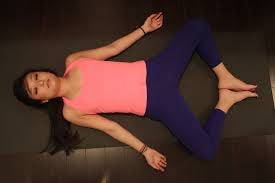
2. Reclining Bound Angle Pose -
Lying on your back with legs outstretched
Bend your knees, bring the soles of your feet together, pull your feet as close to your body as comfortable, relax your arms by your sides with your palms facing upwards.
Feel the weight of your hips sinking down, relax your entire back, feel your head sinking into your pillow
Lying on your back with legs outstretched
Bend your knees, bring the soles of your feet together, pull your feet as close to your body as comfortable, relax your arms by your sides with your palms facing upwards.
Feel the weight of your hips sinking down, relax your entire back, feel your head sinking into your pillow
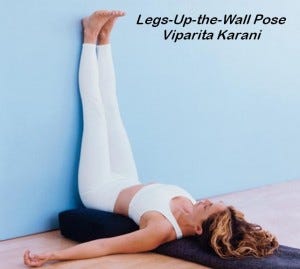
3. Upward Facing Supported Staff Pose —
Lying on your back, with a wall towards your feet
Move your body towards the wall lift your legs up 90° and rest them against the wall.
Your spine and neck should be in a straight line, your legs should be perpendicular to your body,
Relax your hips and legs
Lying on your back, with a wall towards your feet
Move your body towards the wall lift your legs up 90° and rest them against the wall.
Your spine and neck should be in a straight line, your legs should be perpendicular to your body,
Relax your hips and legs
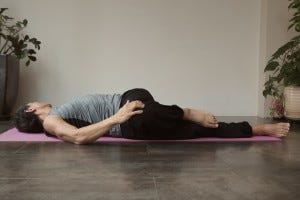
4. Supine Twist -
Lying on your back with your legs together, outstretch your arms at shoulder height, expanding your chest with your palms down and fingers pointing opposite directions
Lying on your back with your legs together, outstretch your arms at shoulder height, expanding your chest with your palms down and fingers pointing opposite directions
Bring your right foot on your left knee, twist to the left bringing your right knee downwards
Turn your neck to the right
Bring both shoulders on the floor, rest your shoulders down
Relax your arms, legs and back
Repeat on the other side
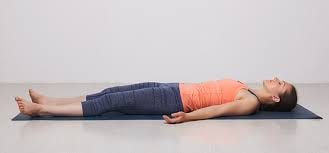
5. Corpse Pose (Savasana) -
Lie back on the mat.
Hug your knees in towards your chest tightly and take a deep inhale.
Exhale and stretch your legs out away from you while keeping your tailbone grounded on the mat.
Your feet should be hips width apart and relaxed away from each other, toward the edges of the mat.
Let your lower back soften and relax. You should not feel any pain or tightness in your lower back.
Relax your arms at your sides, palms facing upward.
Lie back on the mat.
Hug your knees in towards your chest tightly and take a deep inhale.
Exhale and stretch your legs out away from you while keeping your tailbone grounded on the mat.
Your feet should be hips width apart and relaxed away from each other, toward the edges of the mat.
Let your lower back soften and relax. You should not feel any pain or tightness in your lower back.
Relax your arms at your sides, palms facing upward.
Checks to make sure your shoulders are not hunched, and, if so, relax your shoulders away from your ears.
If you are suffering from insomnia, anxiety or stress-induced conditions yoga can be extremely beneficial to relax the body and restore your energy levels, our stretch and restore program will cater to your needs and incorporate deep stretching to relieve tension around your body and deep breathing techniques to help calm your mind.
Comments
Post a Comment