
4 Yoga Poses to Fight Insomnia

Learning how to relax is fundamental to our physical and mental well-being. After a stressful day our bodies and minds may not be able to relax and when lying down to rest or sleep your muscles may continue to carry a certain amount of residual tension which over time can be a constant drain on your energy resources. Corpse pose, or Sivasana, helps to train our minds to consciously let go of any strain, mental and physical in order for us to reach a state of deep relaxation.

When lying in bed tossing and turning to find sleep try lying flat on your back and tense up every muscle in your body, hold it for a few seconds and let it go, feel yourself sinking down into your bed and the tension drifting away. Another exercise you can try is to visualise any tension drifting away as you relax each part of your body from your feet up to your head feeling your whole body heavy and your mind completely calm, taking deep breaths in and long, slow exhalations.

If this helps to relax you but not drift you into sleep, try not to feel restless. Instead get into these 4 poses in bed as they have extremely high restorative properties. Holding each pose for at least 2-3 minutes, closing your eyes and focusing on long, slow exhalations as this helps you to relax. These poses will ensure that your energy is restored and helps to calm your mind and your muscles, so even with a few hours of sleep you wake up feeling refreshed.
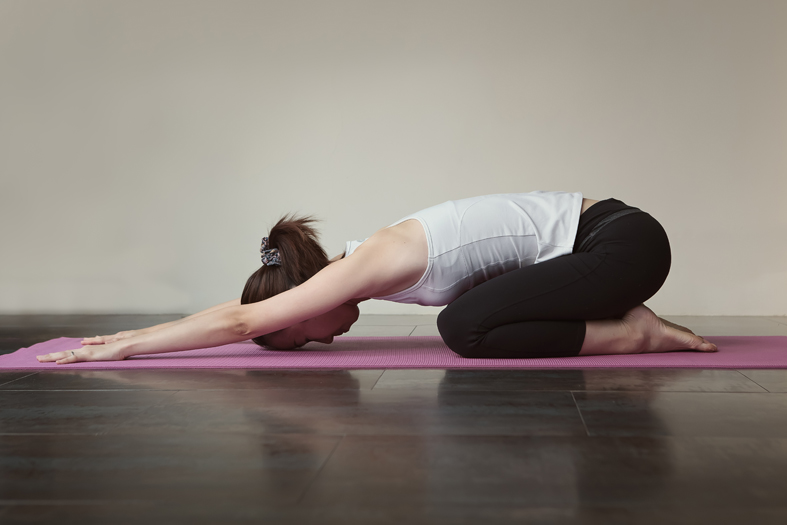
Balasana
  1. Child’s Pose
-Sitting on your heels, keeping your feet and knees together, bending forwards relaxing your abdomen on your thighs.
-Drop your forehead to the floor and relax all the muscles in your neck, back and stomach.
-Relax your arms and your legs
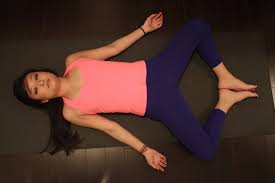
download
  1. Reclining Bound Angle Pose
-Lying on your back with legs outstretched
-Bend your knees, bring the soles of your feet together, pull your feet as close to your body as comfortable, relax your arms by your sides with your palms facing upwards
-Feel the weight of your hips sinking down, relax your entire back, feel your head sinking into your pillow
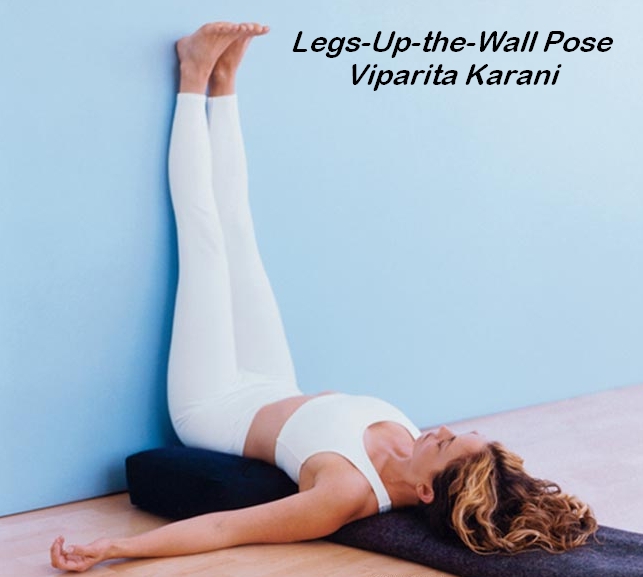
Legs-Up-the-Wall Pose (Viparita Karani)
  1. Upward Facing Supported Staff Pose
-Lying on your back, with a wall towards your feet
-Move your body towards the wall lift your legs up 90° and rest them against the wall.
-Your spine and neck should be in a straight line, your legs should be perpendicular to your body,
-Relax your hips and legs
P-013_Inspire-Alvin_5128 (2)
  1. Supine Twist
-Lying on your back with your legs together, outstretch your arms at shoulder height, expanding your chest with your palms down and fingers pointing opposite directions
-Bring your right foot on your left knee, twist to the left bringing your right knee downwards
-Turn your neck to the right
-Bring both shoulders on the floor, rest your shoulders down
-Relax you arms, legs and back
-Repeat on the other side

If you are suffering from insomnia, anxiety or stress induced conditions yoga can be extremely beneficial to relax the body and restore your energy levels, our stretch and restore program will cater to your needs and incorporate deep stretching to relieve tension around your body and deep breathing techniques to help calm your mind.

Comments

Popular posts from this blog

Yoga at Home: A Beginner’s Guide

  Yoga at home   offers a rejuvenating way to achieve inner peace and holistic well-being. In this blog, we will explore the incredible benefits of practicing yoga at home, guiding you through a transformative journey toward a healthier mind, body, and spirit. How to do Yoga at home   Our aim at Inspire Yoga is to give you the confidence to create a self-practice, where you can start your day by rolling out a yoga mat in the comfort of your own home and have the know-how of what you need, a gentle stretch, an energizing workout or a calming practice, all depending on the day and being mindful to what your body is asking for. Most of the time we push our body and let our mind be in charge of what needs to take place, yoga is the time of listening to what the body needs, to understand where the areas of tension and stiffness are and how to systematically and compassionately release the areas that are feeling stuck, so you enjoy a greater freedom of movement and an increased...

The Basics of Ayurveda

Ayurveda is the ancient science of Indian medicine. It seeks to bring longevity and a greater quality of life by delving into health and healing. Ayurveda determines the wholesomeness of one’s life by examining the harmony in which one lives with themselves and their surroundings. Any ailments on the physical plane is said to be rooted on the level of the mind, thus a healthy body starts with a happy mind. Ayurveda classifies each body according 3 categories (doshas), our bodies will have characteristics that are predominant in at least one of these doshas. The aim here is to know our bodies better and thus know what to avoid and how to nurture it. If we are out of balance, there is too much of one element dominating leading to poor health. The focus is to bring everything into balance, in a holistic fashion. Vata This is the first dosha, it relates to the elements of space and air. Its physical qualities are dry, cold, light and irregular. People who are vata tend to be ...

Stress Management Program

  Stress is embedded into our lifestyles, even children nowadays suffer from stress and anxiety. We have seen radical shifts from the global pandemic, with widespread fear and uncertainty people were worried for their lives, and the safety of their loved ones, they also felt threatened by others. In Hong Kong, we were the last city in the world to drop the mask mandate and social distancing measures, yet you still see many wearing their masks as a choice to protect themselves, many feel exposed and anxious without it and a sense of social awkwardness being put into group gatherings again after 3 years. Our  stress management programs  help our clients feel safe and comfortable again, especially in a changing and highly unpredictable world. The workshops provide a space to feel quiet within and to stop the constant mental chatter. When we are able to feel at peace within we are more willing to connect deeply with others, the program has both these factors intertwined, pers...